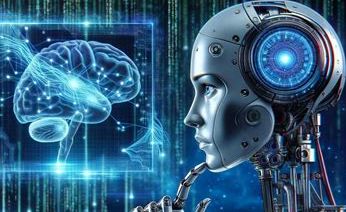
A Moral Position on AI examines the moral issues in AI artificial intelligence, and its use in society from a moral point of view.
What is AI Artificial Intelligence?
AI is simply a computer program made by men (programmers) that seeks to do something. In that sense, it is no different from any other computer program. It can have errors, the programmers can make mistakes or make presumptions that are not based on truth, and at the same time, every AI program has a degree or possibility of a point of view from the makers that is hidden in how it works. For example, the programmers want to push some agenda or particular point of view.
AI is not any more immune from this computer program flaws than any other program.
To be more specific, AI is simply a database of questions and answers that humans have compiled. So as far as any human can think of a question and answer that question, the program can search with blazing speeds through its data and find that question, and respond with the answer some human gave it in its programming phase.
What AI is not
What we need to understand is that AI is not actually intelligence. To define an intelligence, it has to be a person (human), and it has think on its own without a command to do so. If it were possible to make a computer program that would be capable of independent thinking, then it would be amazing. AI today is not amazing. It is just a human tool that is 100% a ´product of human engineering. Having said that, that does not mean that AI dangers should be ignored.
Independent thinking is a key element that AI is lacking. Another key element is critical thinking. In having critical thinking, a person would explore two opposing positions, both with supposedly valid arguments in each, and assign moral values to each. For example, this position is good and this position is bad. Good and bad need to defined. In most cases “good” refers to what promotes a desired outcome. “Bad” would be anything else That moral assigning of goals in part is really behind critical think.
But the issue of critical thinking is what makes AI very difficult. Why? Because if you pose a question to an AI program like how do you persuade a person to be Catholic or Protestant. The entire crux of what you are doing would hinge on whether you are a Catholic wanting to convert Protestants, or a Protestant wanting to convert Catholics. Moreover, there are rules and principles which would have to be used. For example, the absolute authority for a Catholic is the Roman Catholic Church (the institution) and for a Protestant the Bible.
So presuming one or the other as authority would change things greatly. Logic would seem to enter into this process, but actually logic would be used as a slave to the position you have already presumed.
If AI were capable of critical thinking, then it would decide on its own, and persuade against what its programmers had presumed. It cannot do that, and as far as humans are concerned, that process also fails with many humans. Humanity is a very complex and difficult thing to mimic and get it correct. You can put a face and hands on a machine, but it is not a human.
So AI will try to do what it is asked to do. AI has to follow its own internal rules, placed there by the programmers, and it is also limited in what it can perform. Give it a really hard problem like make a cure for cancer, and it just doesn’t work.
How does AI really work?
So this question brings up more problems and limitations. AI works by copying questions and answers, text, into great storage centers, and from there it tears that text apart, indexing key words. When you ask it to give you an answer, it is looking at what it has in its data banks for something similar, and it spits out something similar to that.
Therein is another problem. Why? Because in essence, AI is using humans writings in order to come up with some similar. If we were in school again, then AI would be the kid that is looking at everybody else’s answers in order to get a right answer. But there are problems in this. Is doing that legal? Actually, in school, that kid is punished if he is found doing that. Why? Because he didn’t do his own work. In other words, he did not learn the material like everybody else, and he did not formulate answers on his own. He used other people in order to get a right or close to right answer.
In school, the kid who copies other people’s work learns very fast, if he sits in the back of the class with other dumb people, and he copies the answers of other dumb people, he flunks the test. So for as smart as the copier kid thinks he is, he is really dumb actually. You don’t copy from other people that are as dumb as you are or dumber than you are.
AI copies everything. It consumes everything. It has no way of evaluating each piece of text to see if it is great, good, average, or wrong, or just plain dumb. A judge in California I believe was said to be rebuking strongly a lawyer that made a legal argument before the judge using AI. The issue was that the AI cited non-existent legal precedents. So this issue of copying anything and making the moral decision to invent or create something that does not exist, or exists only in scifi, fiction, or novels that are not based on real life, is a moral pitfall for AI. The real problem here is that the programmer saw this as a valid possibility and programmed that “feature” into his version of AI.
Copyright Law
Under US copyright law, an author has control over the use of his work for a certain period of time. Deciding whether a work is still under copyright or not is a process that only a human can do well. Sometimes it is easy, and other times it is difficult.
But this principle in law is that people other than the author cannot use an author’s writing without getting permission, and in many cases, this means paying the author in order to use their work. The author can waive this principle, but even so, people cannot change the author’s name and post it as their own. People cannot sell another person’s work and make money off of it without the author’s permission, and again, usually there is an exchange of money.
Furthermore, nobody can use an author’s work and make textual changes to that work, whether they are significant or not. Another another has to quote the work, using quotation marks around the text and give a footnote to the original work and author.
If the law’s copyright time limit has expired (which is complicated because other country’s have different laws, and even our own country’s copyright laws have changed over time), but if the time limit has expired, then the work is considered public domain. The rules change at that point. Basically as far as the law is concerned, you can do anything you want to do with the work once it is in public domain. Ethically, the above rules about quotation marks and footnote to give credit to the original author still applies. Any author that abuses another person’s writing, even once it is in the public domain, then that author that abuses is considered a bad writer. He is morally corrupt.
AI is totally about using other people’s works, in the public domain or still under copyright, and not giving credit as a rule. There are some signs that the original source is getting credit in basically Internet Search Engines, but AI not so much. Even when AI gives credit to an original source, there is no guarantee that it cited the original source exactly as in that original source.
So the entire process is based on what is called AI learning where the program “learns”, i.e. copies text, analyzes it, assigns key words and synonyms, and makes it available to itself quickly. When AI is learning, it is essentially copying people’s knowledge embeded in their writings. AI makes very little distinction between the copyright status. Those programmers that are programming and directing the learning part are the ones who decide, and they are not steering it away from copyrighted works. The basic principle they are using is everything is legitimate if we can access it, if we can get it. No avoiding copyrighted works, no real attributes to the original source. So they are just taking everything like a thief.
So the lawmakers need to step in here. They don’t necessarily need to make laws for or against AI, but rather define exactly what are the limits and permissions in using works.
If AI is asked to write a story such as Homer’s the Iliad and the Odessy, and specifically make all the characters monkeys, that would be in poor taste. But alas that is our day. Somewhere there has to be a fence that stops use of anything in anyway, including for purposes of shaming and making fun of other people. While people have the right to have a different opinion, they should respect at some level those different opinions from their own. So anything that a person can do, they maybe shouldn’t do.
In AI, the question is that some of it is good enough to pass for an original work (pictures and writings), and all AI is ultimately being created for income purposes, although that is not apparent at present all the time. People do not spend millions or billions of dollars without an end game. They will accomplish something that they desire through their efforts, and that usually has an economic angle to it. Even politicians using propaganda at their own expense is so that they can get into government, and then they will make their money.
What are the Morality Elements in AI
The problem then is that AI is complicated, and the moral directives of those who create and push it are hidden. It is very difficult for example to prove that SEO search engine results are skewed towards a particular bias or predujice. But some have done that. So is that fair game? Do we ignore and allow AI and its creators to do that?
The quick answer would be no. Laws should be made to prevent that. But the more in depth answer is that the problem is in our society. They consider that AI is absolutely true and right all the time, i.e. there is some kind of authority to what it gives them because it came from a computer, and from AI. That is the flaw at the bottom of everything.
As law suits come out against AI because a medical AI gave poor medical advice and reveal AI’s inherent problems, then the shine and glow of AI will wear off. If you ask yourself, who gave the medical AI program its understanding of medicine, a veteran doctor of 40 years experience? Or some med school drop out that sold his soul to a medical AI startup. There is where the real problem and solution can be seen.
In other words, transparency. Drop the veil of being a computer program, and cite your sources clearly and always, and also the sources (credentials) of the medical people who helped program the medical AI. If the people who gave that program medical advice have no medical credentials except what they saw on TicToc, then that should be apparent in the information given out. I watch youtube videos. It greatly frustrates me when I see supposed “experts”, doctors who are giving advice about diabetes, and when you can trace down the credentials of that doctor, he is a chiropractor. His field of study has nothing to do with diabetes. While that is very bad, I suspect that in modern AI, there are close to kids in high school programming these AI machines. A car can be dangerous, and should be kept away from kids, and even adults (like alcoholics) when they abuse it.
So in conclusion, morally, AI is just a tool, and depending on the person manipulating it, it can be used for good or bad. A knife can kill a person in the wrong hands, and in a surgeon’s hands, it can save lives. AI should be viewed as the same. But just as we make laws on people who use dangerous things, we need to have some legal boundaries for those who make and use AI.
The China Angle
China has discovered this tool, and they aer using it. But their point is to use it to control any criticism of their own Communism and destroy America (capitalism). No matter what laws the US makes, China will continue on their same course. So the tool cannot be simply prohibited, because that would give them the advantage. Yet if there are more integrity controls, such as footnoting, credentials of where and the quality of information presented, etc., then the less people will look to the Chinese AI and will lean more to the American version of this tool.
A Moral Position on AI
 How can a loving God send people to hell? explains how God's love interacts with God's judgment and wrath. Love has to involve two people, and when somebody does not respond correctly to God's love, God is despised and spurned, therefore it is logical that God excludes that person from all the God has to offer.
(https://www.theologicalsystems.com/god/how-can-a-loving-god-send-people-to-hell/)
How can a loving God send people to hell? explains how God's love interacts with God's judgment and wrath. Love has to involve two people, and when somebody does not respond correctly to God's love, God is despised and spurned, therefore it is logical that God excludes that person from all the God has to offer.
(https://www.theologicalsystems.com/god/how-can-a-loving-god-send-people-to-hell/)

 Biblical Definition of Spiritual Abuse
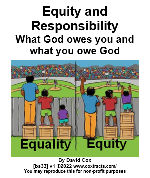 bs33 Equity and Responsibility